

Taiwan Pilot Tests a New Measure of Circular Value
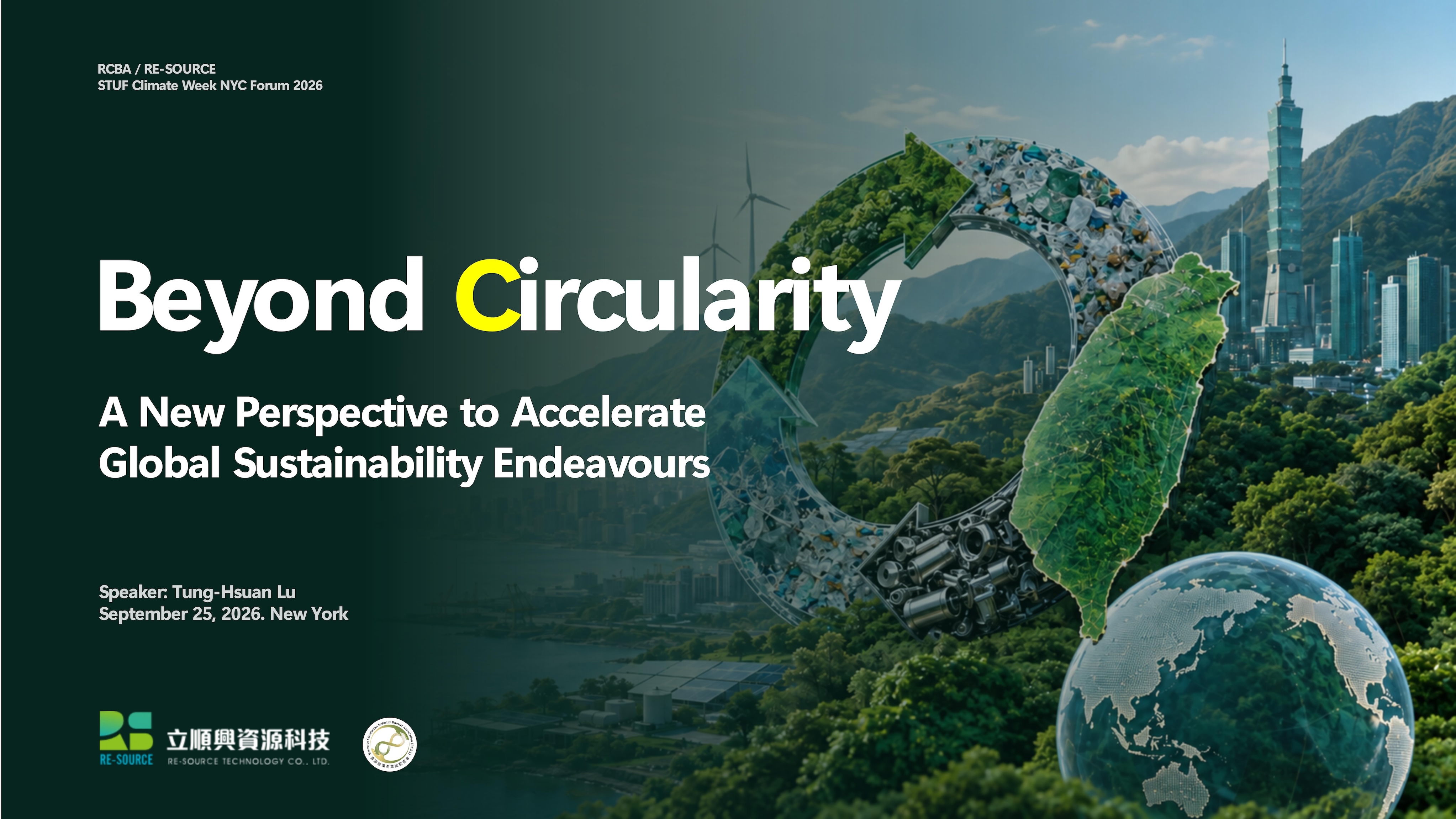
Tung-Hsuan Lu of RCBA and RESource Technology Co., Ltd. will present the Beyond Circularity framework at the STUF United Fund Climate Week NYC Forum 2026.
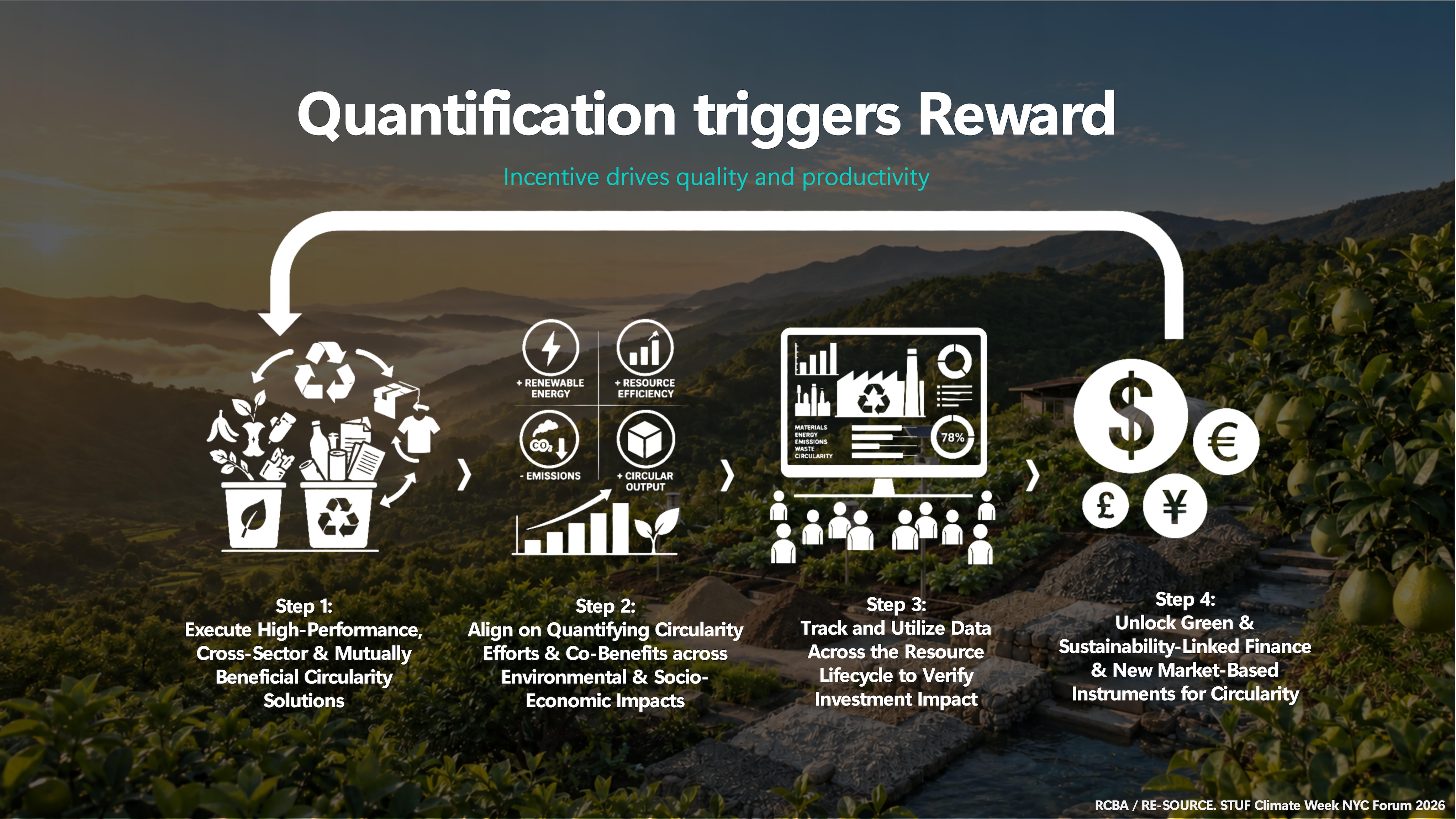
The proposed framework links circular action with measurement and verification, while exploring potential pathways to sustainable finance and future market-based instruments.
At Climate Week NYC, a Miaoli initiative will link materials, regenerative agriculture and biodiversity data to demand for verifiable circular performance.
Tung-Hsuan Lu, representing the Resource Circulation Industry Booster Association (RCBA) and serving as General Manager of RESource Technology Co., Ltd., will bring that question to New York through a framework called Beyond Circularity. The approach draws on pilot activities in Miaoli County that combine material reuse, regenerative farming, biodiversity baselines and community participation.
Circularity Moves Beyond Waste
The timing reflects a broader shift in the international circular-economy debate. Climate Week NYC's official 2026 programme includes circular supply chains in its transport and industry agenda, while another listed event focuses on redesigning products, operations and value chains to keep materials in use. Taken together, the programme frames circularity as an industrial and value-chain issue, not simply a recycling target.
The resource challenge is also becoming harder to separate from climate and nature. The United Nations Environment Programme's Global Resources Outlook 2024 warned that, without urgent and concerted action, global resource extraction could rise 60% from 2020 levels by 2060. UNEP also identified reducing the resource intensity of food, mobility, housing and energy systems as essential to meeting climate and sustainability goals.
Against that backdrop, companies face growing expectations to show where materials come from, how long they remain in use and whether circular strategies produce credible environmental benefits. Published in May 2024, ISO 59020:2024 provides requirements and guidance for organizations to measure and assess circularity performance within defined economic systems. The standard reflects growing demand for more consistent, transparent and verifiable evidence of circular-economy performance.
Miaoli as a Test Bed
The Taiwan initiative uses Miaoli as a real-world setting for what Lu describes as Circular Metabolism: a system linking inorganic material circulation, organic regeneration and social participation.
The work is being developed with technology, research and academic partners, including Napital, NCU.fi and Chung Yuan Christian University. Its pilots cover three connected areas: regenerative farming and youth participation; biodiversity baselines and agroforestry models in pomelo-growing landscapes; and applications for circular materials that may support resilience and nature-based solutions.
Rather than treating these activities as separate sustainability projects, the framework is intended to examine how their results can be tracked together. Measures under consideration include circular efficiency, circular maturity, ecosystem services, climate adaptation, resilience and social value.
From Evidence to Finance
At the center of the proposal is a Circularity Capital Index. The index remains under development and is not being presented as an established credit or financial product. Its purpose is to explore whether a consistent set of indicators could make circular performance more transparent and comparable, while giving investors and other stakeholders better evidence for evaluating environmental and socioeconomic value.
The proposition can be summarized in three steps: real action creates measurable value; measurable value builds trust; and trust can create a foundation for credit. The difficult work lies between those steps - establishing reliable data, verification and governance before environmental performance can support financial decisions.
"We invite the world to come to Taiwan and see our real-world pilots - to see how real assets can be quantified into value, how value can build trust, and how trust can become credit," Lu said.
A New York Platform
Lu will present Beyond Circularity: A New Perspective to Accelerate Global Sustainability Endeavours on Sept. 25 at the STUF United Fund Climate Week NYC Forum 2026 at STUF's New York headquarters https://www.stuf-climate-week-2026.com/.
Held under the theme Circular Economy and Green Finance: Local Solutions and Global Opportunities, the forum will bring together perspectives from policy, academia, industry and finance, including contributions from Taiwan's Financial Supervisory Commission and Johns Hopkins University.
For the Miaoli pilots, the New York presentation is less a declaration of a finished model than an invitation to test it: to compare methods, strengthen the evidence base and determine whether local circular practices can meet the standards of trust expected in international markets.
George Hu
RESource
email us here
Legal Disclaimer:
EIN Presswire provides this news content "as is" without warranty of any kind. We do not accept any responsibility or liability for the accuracy, content, images, videos, licenses, completeness, legality, or reliability of the information contained in this article. If you have any complaints or copyright issues related to this article, kindly contact the author above.
